Poduromorpha · Hypogastruridae
Xenylla humicola
A hobby culture called Tiny Green. Little is written about it yet.Known on this site only as the hobby culture Tiny Green. No source read for this site describes the animal.
Also sold or known as
This page is a stub
It records the name, a drawing and what the sources say so far. Sections that say nothing is recorded are waiting for evidence.
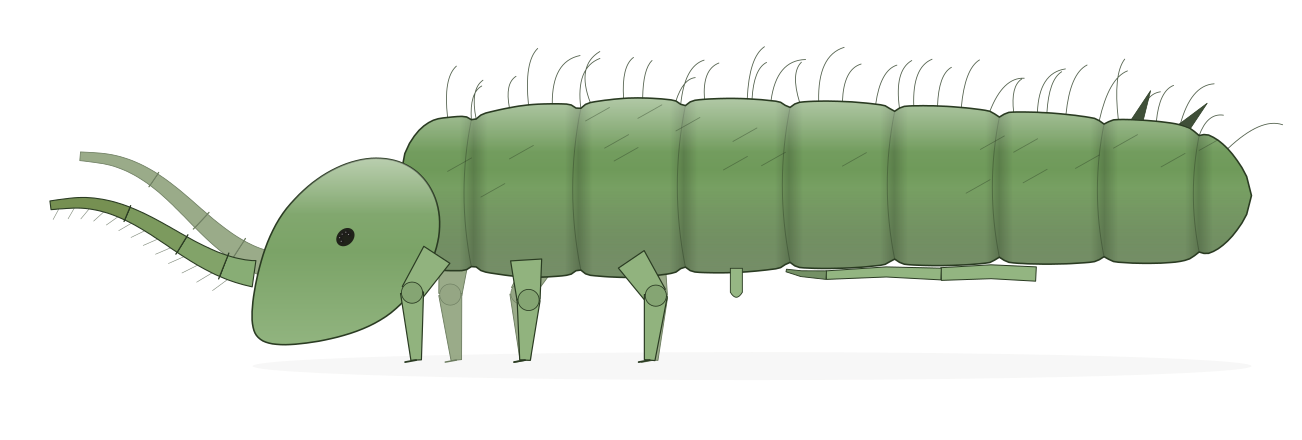
No size is recorded for this species yet, so true size is not available.
At a glance
- Identification
- Probable Stable How sure we are
Not recorded yet: Size, Difficulty, Growth, Temperature, Air humidity, Best enclosures.
Identification
Characters to check
These are the features recorded for this species. Each row says what kit you need to read it.
| Character | What it looks like | Needs |
|---|---|---|
| Body form | Short and plump The body is short, broad and grub-like with a rounded outline. / Slim tube The body is a smooth tube with segments you can see, and shorter antennae and legs. Varies Inherited: Poduromorpha | Naked eye |
| Surface texture | Finely grainy The skin looks fine-grained, like very fine sandpaper, with no knobs. Inherited: Hypogastruridae | Hand loupe |
| Scales | No scales The body has no scales, only skin and bristles. Inherited: Poduromorpha | Hand loupe |
| Antenna length | Shorter than half the body The antennae are short and stubby, clearly less than half the body length. Inherited: Poduromorpha | Phone macro |
| Antenna segments | Four plain segments The antenna has four clear segments and none is divided into rings. / Divided into rings At least one segment is split into small rings, which makes the antenna look jointed. Varies Inherited: Collembola | Stereo microscope |
| Mouth shape | Blunt mouth The mouth is blunt and the head is rounded in front. Inherited: Hypogastruridae | Hand loupe |
7 characters have no record yet
Nobody has recorded these for this species, so the key treats them as unknown and never guesses.
- Body length
- Main colour
- Colour pattern
- Eyes
- Eye count
- Spines on the tail end
- Jumping organ
Identify an animal you have
Answer in any order, with the kit you have.
Husbandry and breeding
No husbandry data is recorded for this species yet.
Tools
Bioactive compatibility
Fit by enclosure type
No temperature or moisture range is recorded for this species, so no fit can be estimated yet. Missing data is never scored as a poor fit.
Animals that eat springtails mean the springtails need topping up. The explorer shows which species keep up with the animals in your enclosure. Open the compatibility explorer
Natural history and distribution
No distribution is recorded for this species yet.
Taxonomy and naming history
How sure the name is
- Name type
- Exact name The name has been matched against the published description.
- Confidence
- Probable More likely than not, with gaps left.
- Evidence for the name
- Trade label only
- Stability
- Stable Sources agree and the name has not moved in years.
- Review
- Imported, not reviewed
GBIF lists Xenylla humicola (O.Fabricius, 1780). Checked Oct 22, 2026.
Classification
Trade and hobby names
Trade names are not taxonomy. Each one is a label that sellers use, with its own page.
| Name | Kind | How likely |
|---|---|---|
| Tiny Green | Trade name | Probable |
External records
Open questions and sources
Open questions
-
What do the published descriptions say about species that only have a hobby name here?
Identification Open
Why it matters. Several pages are stubs because no description was read for this site. Their identification traits, size and range are therefore blank.
What would help. The original and modern descriptions of each species, with measured lengths and diagnostic characters, added with proper citations.
-
Which species is this culture, checked by a specialist?
Identification Needs a voucher specimen
Why it matters. Hobby cultures are mostly named from a seller's label or a photograph. A wrong name spreads from seller to keeper and then into care advice.
What would help. Preserved vouchers from the culture in 80 to 95 percent ethanol, mounted specimens examined by a springtail specialist, and a DNA barcode where a reference exists. Deposit the voucher with a museum or a university collection.
Sources
- 1
Biology of the Springtails (Insecta: Collembola)
Hopkin SP. 1997. Oxford University Press
Verified against a registry · Specialist monograph
Cited at chapter on external morphology.
- 2
The Collembola of Fennoscandia and Denmark. Part I: Poduromorpha
Fjellberg A. 1998. Brill
Verified against a registry · Specialist monograph
Cited at Hypogastruridae; introduction.
- 3
Checklist of the Collembola of the World
Bellinger PF, Christiansen KA, Janssens F
Link works · Authoritative database
Cited at Introduction, external anatomy and morphology.
Spotted a mistake or know a better source?
Page data reviewed Oct 22, 2026