Isotomurus cf. louisiana
A green springtail for wet setups. Its species name is still tentative.A green springtail sold as the Green Water Springtail. Its species is tentative, so the name carries cf.
Also sold or known as
Working identification: cf. (compare with)
It looks like this species but has not been confirmed. cf. does not confirm a name.
This page is partly filled in
Some sections have little or no evidence yet. Each gap says so rather than guessing.
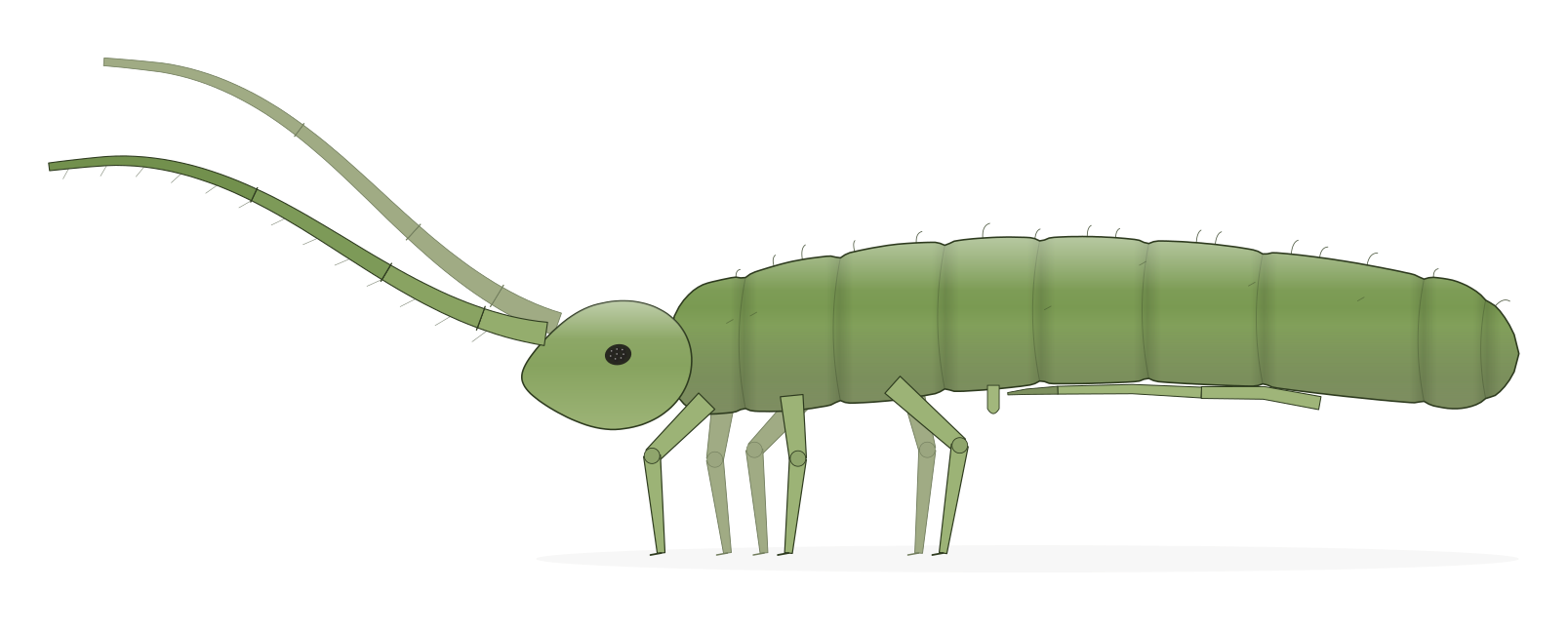
No size is recorded for this species yet, so true size is not available.
At a glance
- Difficulty
- Expert
- Growth
- Fast
- Best enclosures
- Closed tropical terrarium, Temperate woodland vivarium A model estimate from the ranges on this page. See every enclosure type
- In trade
- Regularly available As of Oct 22, 2026.
- Identification
- Tentative Under active research How sure we are
Not recorded yet: Size, Temperature, Air humidity.
Identification
Characters to check
These are the features recorded for this species. Each row says what kit you need to read it.
| Character | What it looks like | Needs |
|---|---|---|
| Body form | Slim tube The body is a smooth tube with segments you can see, and shorter antennae and legs. Inherited: Isotomidae | Naked eye |
| Main colour | Green or olive Green, olive or green grey. | Naked eye |
| Scales | No scales The body has no scales, only skin and bristles. Inherited: Isotomidae | Hand loupe |
| Antenna segments | Four plain segments The antenna has four clear segments and none is divided into rings. / Divided into rings At least one segment is split into small rings, which makes the antenna look jointed. Varies Inherited: Collembola | Stereo microscope |
| Mouth shape | Blunt mouth The mouth is blunt and the head is rounded in front. Inherited: Entomobryomorpha | Hand loupe |
| Spines on the tail end | No spines The last abdominal segment has no spines. Inherited: Entomobryomorpha | Stereo microscope |
7 characters have no record yet
Nobody has recorded these for this species, so the key treats them as unknown and never guesses.
- Body length
- Colour pattern
- Surface texture
- Antenna length
- Eyes
- Eye count
- Jumping organ
Identify an animal you have
Answer in any order, with the kit you have.
Husbandry and breeding
- Difficulty Expert
- Growth Fast
- Yield High
- Airflow
- Low
Foods
- Commercial springtail mix Good
- Dry yeast Good
- Fish flakes Occasional
Substrates
- Calcium clay Good
- Plain plaster Good
The evidence in detail
Tools
Bioactive compatibility
Fit by enclosure type
A model estimate from the climate each enclosure type holds and the ranges recorded for this species. It is not a measurement.
| Enclosure type | Fit | Why |
|---|---|---|
| Closed tropical terrarium A glass terrarium with a lid and little ventilation, misted often, kept for dart frogs and other animals from humid forest. See where it ranks | Good fit |
|
| Temperate woodland vivarium A cool, damp vivarium with leaf litter, bark and a moisture gradient, kept for fire salamanders and similar woodland amphibians. See where it ranks | Good fit |
|
| Open tropical terrarium A tall terrarium with mesh ventilation and daily misting that dries out between sprays, kept for crested geckos and similar climbers. See where it ranks | Marginal fit |
|
| Isopod tub A ventilated tub of organic substrate and leaf litter with a damp end and a dry end, kept for isopod colonies. See where it ranks | Marginal fit |
|
| Potted plant A houseplant pot with an open top, watered on a schedule so the soil dries a little between waterings. See where it ranks | Marginal fit |
|
| Semi-arid terrarium A mostly dry terrarium with a damp hide and a warm spot, kept for leopard geckos and similar grassland or scrub animals. See where it ranks | Marginal fit |
|
| Arid terrarium A dry, well ventilated desert terrarium with a hot basking spot, kept for bearded dragons and similar animals. See where it ranks | Poor fit |
|
Animals that eat springtails mean the springtails need topping up. The explorer shows which species keep up with the animals in your enclosure. Open the compatibility explorer
Natural history and distribution
- In trade
- Regularly available in North America. As of Oct 22, 2026.
Taxonomy and naming history
The sources disagree about this name
- The Checklist accepts Isotomurus louisiana
- GBIF accepts Isotomurus louisiana
How sure the name is
- Name type
- cf. (compare with) It looks like this species but has not been confirmed. cf. does not confirm a name.
- Compared with
- Isotomurus louisiana
- Confidence
- Tentative A best guess that needs checking.
- Evidence for the name
- Body form, checked by an expert
- Stability
- Under active research Researchers are still working out what this is.
- Review
- Reviewed by a curator
GBIF lists Isotomurus cf. louisiana (Scott, 1962). Checked Oct 22, 2026.
Classification
Trade and hobby names
Trade names are not taxonomy. Each one is a label that sellers use, with its own page.
| Name | Kind | How likely |
|---|---|---|
| Green Water Springtail | Trade name | Likely |
| Isotomurus retardatus | Historical label | Likely |
| Green Water | Trade name | Tentative |
Names used
| Name | Relationship | Author | Note |
|---|---|---|---|
| Isotomurus retardatus | Historical trade identification | The earlier label. The seller says the old identification was difficult to acquire. |
External records
Open questions and sources
Open questions
-
Is the Green Water culture the species *Isotomurus louisiana* or a close one?
Identification Needs a specialist
Why it matters. Colour pattern is a known problem for separating species of Isotomurus. The seller kept cf. on the name for that reason.
What would help. Slide-mounted adults checked against setae characters, with a COI barcode.
-
Which species is this culture, checked by a specialist?
Identification Needs a voucher specimen
Why it matters. Hobby cultures are mostly named from a seller's label or a photograph. A wrong name spreads from seller to keeper and then into care advice.
What would help. Preserved vouchers from the culture in 80 to 95 percent ethanol, mounted specimens examined by a springtail specialist, and a DNA barcode where a reference exists. Deposit the voucher with a museum or a university collection.
Sources
- 1
Major Springtail Hobby Identification Updates (2026)
Pavy R. 2026. Springtails US
Link works · Retailer
Cited at Isotomurus retardatus Green Water Springtail.
- 2
- 3
Springtail Identification and Common Name Resource
Pavy R. Springtails US
Link works · Retailer
Cited at Green Water Springtail Isotomurus retardatus.
- 4
Biology of the Springtails (Insecta: Collembola)
Hopkin SP. 1997. Oxford University Press
Verified against a registry · Specialist monograph
Cited at chapter on external morphology.
- 5
Checklist of the Collembola of the World
Bellinger PF, Christiansen KA, Janssens F
Link works · Authoritative database
Cited at Introduction, external anatomy and morphology.
Spotted a mistake or know a better source?
Page data reviewed Oct 22, 2026