Good to know

The springtail life cycle

A springtail hatches from an egg as a small copy of its parents and keeps growing and moulting for life. This guide follows one animal from egg to adult and gives the times measured for Folsomia candida.

6 min read · For Beginner, Keeper, Specialist

The cycle at a glance

Five round views in a ring, with an arrow from each to the next. In the first view, at the top, six round eggs lie together in a clump. In the second, one swollen egg has its split shell drawn back to a cap at each end. In the third, a tiny young springtail stands near two empty pieces of shell. In the fourth, a larger young springtail stands beside a pale dashed outline of the skin it has shed. In the fifth, an adult springtail stands near three eggs, and an arrow leads from this view back to the first.

  1. Eggs are laid together on a surface
  2. The egg swells and its shell splits in two
  3. The young hatches, pale and still
  4. It grows and moults, looking like a small adult
  5. The adult keeps moulting and lays eggs about every other moult
The life cycle of a springtail, with the sizes simplified. Egg colour differs between species, so the eggs are drawn plain. 1–5

The egg

A female springtail lays her eggs on a surface and does not stay to guard them.A female springtail lays her eggs on a surface and leaves them there. In some species the eggs can wait through a long diapause, a pause in development. Expert source 1 Report
A female lays her eggs together in a batch. In one laboratory study a batch could hold well over a hundred eggs.Eggs are laid in batches. In the classic laboratory study of Folsomia candida, females at 15 °C59 °F commonly laid 160 to over 200 eggs in one egg-laying, and the most recorded at 21 °C70 °F was 157. Peer-reviewed 2 Report
A springtail egg is a tiny ball, just over a tenth of a millimetre across.A fresh Folsomia candida egg measures 0.110 to 0.126 mm across. The eggs of many springtail species fall between 0.12 and 0.20 mm. Expert source 3 Report
The shape, colour and shell of an egg differ from one springtail species to the next. Eggs of Desoria albella are glistening white, and eggs of Cryptopygus antarcticus are orange-red. Expert source 3 Report

Hatching

The egg swells as the young grows inside it. Its shell then splits into two small caps, one at each end.The egg swells as the young develops inside. In Folsomia candida it grows from 0.110 to 0.126 mm when laid to 0.180 to 0.185 mm near hatching. Its shell splits and forms two caps, one at each end of the egg. Expert source 3 Report
A Folsomia candida egg hatches after about 7 to 10 days. Expert source 3 Report
A newly hatched springtail is a pale speck about a third of a millimetre long. It rests for a while before it starts to move.The Checklist gives a newly hatched Folsomia candida as about 0.35 mm long. It adds that newly hatched springtails are pale, though the eye patches are coloured in well pigmented species, and that the young stay still for a while before they start to move. Expert source 3, 4 Report

Growing up and moulting

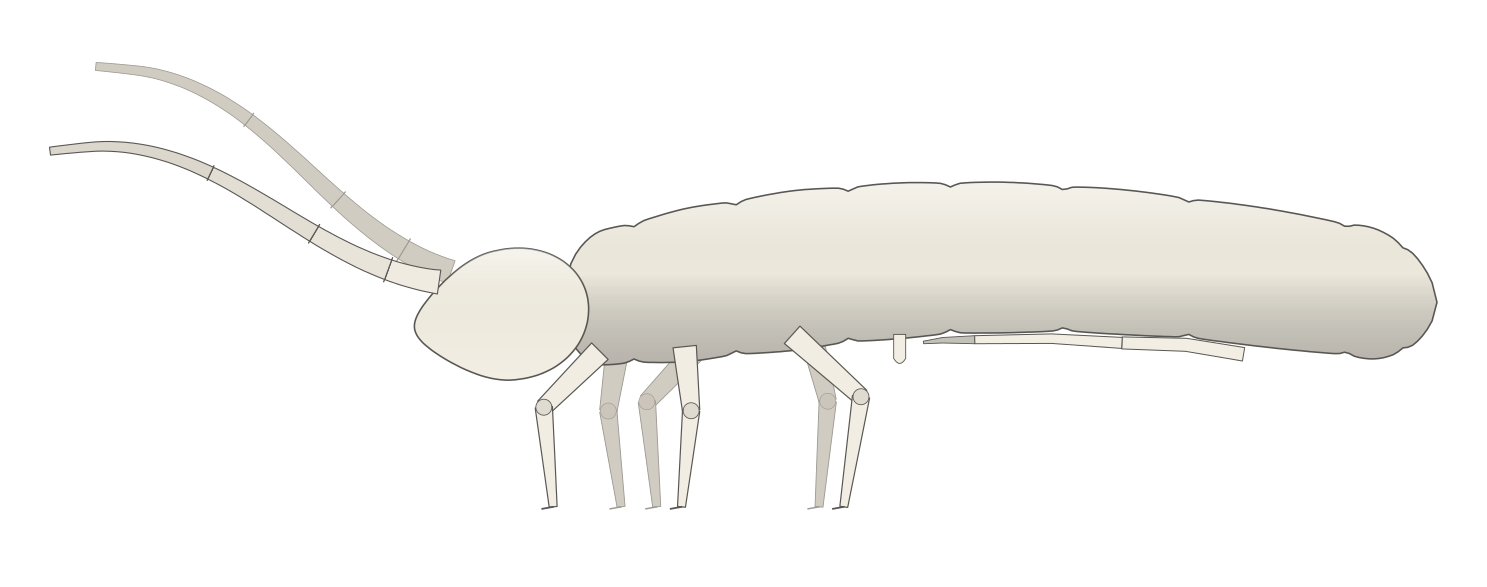
A young springtail looks like a small adult. It never changes into a different shape.Springtails do not metamorphose. The young hatch looking like small adults. As they grow, the changes are mostly in size, colour and the finer detail of the antennae and the jumping organ, the furcula. Expert source 1, 4, 5 Report
A young springtail sheds its skin several times as it grows, usually four or five, before it can breed.A young springtail moults 3 to 12 times before it can breed, depending on the species. Four or five moults is usual. Expert source 1, 5 Report
At 21 °C70 °F a young Folsomia candida moulted about every four days. The gaps grew longer as it aged, and they were longer still in the cool.At 21 °C70 °F the first nine instars of a young Folsomia candida each lasted 3.6 to 4.9 days on average, so it moulted about every four days. At 15 °C59 °F they lasted 5.2 to 7.2 days. The gaps between moults grew longer with age. Peer-reviewed 2 Report
In the family Hypogastruridae a moult takes 20 to 45 minutes. The animal goes still, and the old skin splits along the back from the head backward. The animal steps out and rests for about 15 minutes before it walks. It does not eat the old skin. Expert source 4 Report
The Checklist says that after each moult a springtail feeds, and that before the next moult it fasts. Expert source 4 Report

Adults and egg laying

Springtails have separate sexes, and sperm passes between them indirectly. A male leaves small packets of sperm, called spermatophores, on a surface, and a female finds and picks one up. Expert source 1 Report
Some springtails need no male. Nearly all cultures of Folsomia candida are all female and breed on their own.Some species breed without males. Most Folsomia candida populations reproduce without mating, so every animal is a female, though some wild populations are sexual. Peer-reviewed 1, 6, 7 Report
A female lays eggs about every other time she moults, with one stage of feeding in between.Egg laying follows the moults. In general a female lays eggs about every other moult, with an instar of feeding in between. Expert source 3, 5 Report
At 15 °C59 °F and 21 °C70 °F the Folsomia candida females laid eggs mostly in the sixth, eighth, tenth and later even-numbered instars. At 26 °C79 °F only 53 percent started laying in the sixth instar, and the rhythm was less regular. Peer-reviewed 2 Report
A springtail keeps shedding its skin for its whole life, though it grows only a little once it can breed.Springtails keep moulting after they can breed, and they keep growing slowly. The most instars reported are about 50 in Orchesella, while the globular springtails, the Symphypleona, have at most about 10. Expert source 1, 4, 5 Report

How long it takes

One laboratory strain of Folsomia candida at three temperatures
Measure15 °C59 °F21 °C70 °F26 °C79 °F
First eggs after hatching, in days27.517.720.6
Life span, in days24113672
Eggs laid in a life1,3441,011130

2

A Folsomia candida female passed through about 30 instars in her life at 15 °C59 °F and 21 °C70 °F. At 26 °C79 °F she passed through about 16, and no female had more than 22. Peer-reviewed 2 Report
Life spans in other springtails vary widely. The Checklist gives a maximum of about 32 days in Sminthurinus and 270 days in Orchesella, and about 6 to 18 months in the Hypogastruridae. Massey says springtails usually live less than a year, though some live longer. Expert source 1, 4 Report
See what these times do to a growing culture in the culture simulator Open

Sources for this guide

  1. 1

    Soil Bugs: an illustrated guide to New Zealand soil invertebrates, Collembola (springtails)

    Massey University

    Link works · Expert observation

    Cited at Notes on biology.

  2. 2

    The Life History of Folsomia Candida (Willem) (Collembola: Isotomidae) Relative to Temperature

    Snider RM, Butcher JW. 1973. The Great Lakes Entomologist 6(4)

    Verified against a registry · Peer-reviewed paper

    Cited at Egg production; Instar duration, Table 2; Table 1; Egg production, Table 5; Longevity and mortality.

  3. 3

    Checklist of the Collembola: The Egg

    Janssens F

    Link works · Authoritative database

    Cited at The egg, colour and shape; The egg, Folsomia candida; The egg, newly hatched young; The egg, egg production and moulting; The egg, egg sizes; The egg, incubation period.

  4. 4

    Checklist of the Collembola: Physiology

    Janssens F

    Link works · Authoritative database

    Cited at Post-embryonic development; Moulting cycle; Exuviation.

  5. 5

    Class Collembola, ENT 425 General Entomology

    North Carolina State University, Department of Entomology and Plant Pathology

    Link works · Expert observation

    Cited at Development; Life History and Ecology; Fun Facts.

  6. 6

    Intraspecific Phenotypic Variation and Morphological Divergence of Strains of Folsomia candida (Willem) (Collembola: Isotomidae), the "Standard" Test Springtail

    Tully T, Potapov M. 2015. PLOS ONE 10(9): e0136047

    Verified against a registry · Peer-reviewed paper

    Cited at Introduction.

  7. 7

    High-quality genomes reveal significant genetic divergence and cryptic speciation in the model organism Folsomia candida (Collembola)

    Luan Y, Cui Y, Chen W, Jin J, Liu A, Huang C, Potapov M, Bu Y, Zhan S, Zhang F, Li S. 2023. Molecular Ecology Resources 23(1): 273-293

    Verified against a registry · Peer-reviewed paper

    Cited at Introduction.

Reviewed Oct 23, 2026